
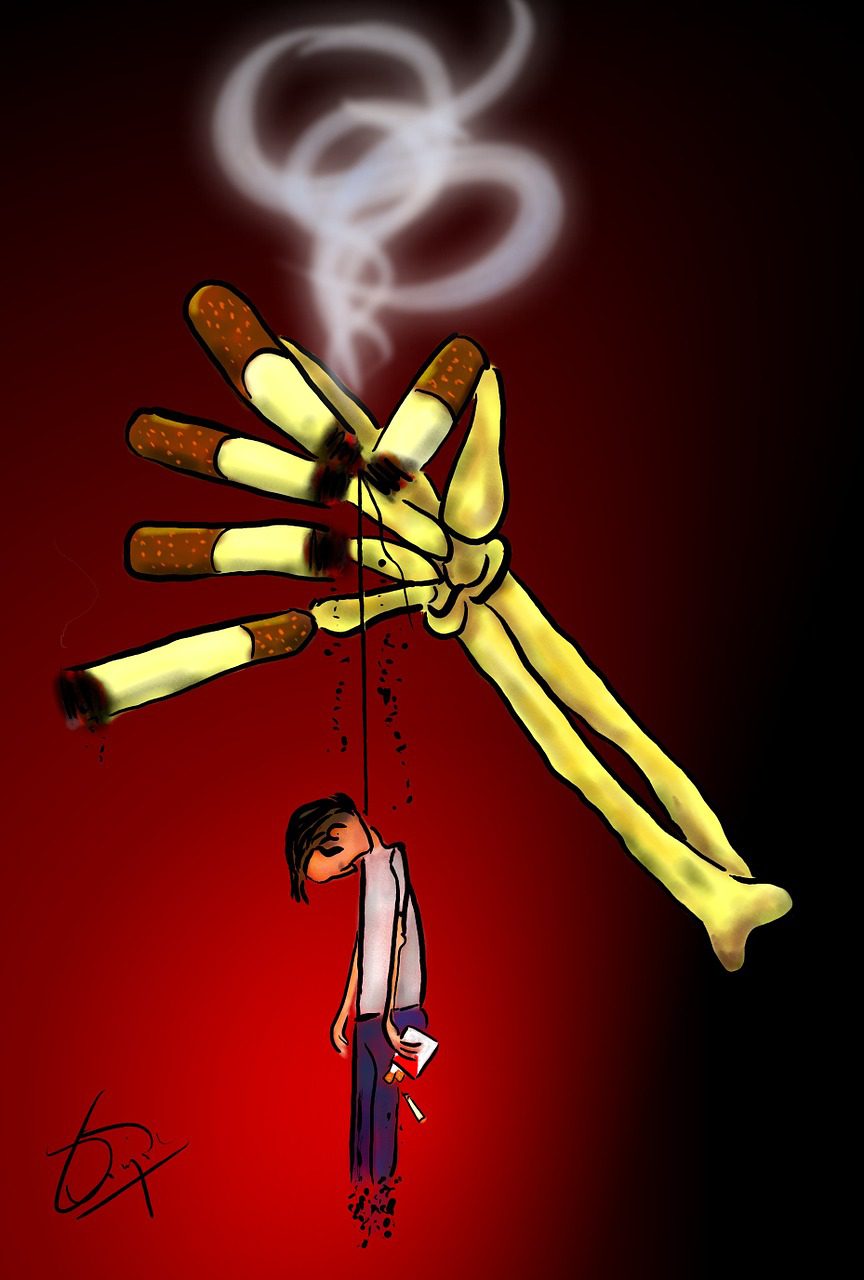
How Harmful Is Smoking?
In all the history of human habit, there have been few changes so remarkable as the tidal-wave increase in cigarette smoking. Within our lifetime a new habit has taken hold to an extent we do not begin to realize, and with effects that we certainly do not understand.
In Britain, in 1961, 30 million people consumed 120,000 million cigarettes. Three out of four men, one out of two women, one out of every four boys of school-leaving age smoke cigarettes. The average consumption is fifteen cigarettes a day. In fact, taking the population of the country as a whole, smokers and non-smokers, the number of cigarettes smoked averages out at 2,400 per annum per person. Some £1,200,000,000 a year are spent on cigarettes alone, making 7 percent of all consumer spending. Up and up runs the graph at a towering angle, with no sign of leveling off.
What is this substance which we breathe into our mouths and lungs in such stupendous clouds? It contains a number of omin- ous-sounding chemicals. Two of the chemicals are under grave suspicion: benzopyrene, which chiefly affects the respiratory tract, and nicotine.
Nicotine
Nicotine is the essential ingredient of tobacco. It is what makes tobacco tobacco and not just another weed. When one smokes, most of the nicotine escapes into the air. About a third gets into the mouth, where a little is absorbed. Of what goes into the lungs, perhaps a fifth is absorbed. A pipe gives one a trifle more nicotine than does a cigar.
The hotter the burning surface, the more nicotine is taken into the system. Thus, the faster one smokes, the more nicotine one gets; smoking twice as fast results in ten times as much nicotine. And the closer to the end of a cigarette one smokes, the more nicotine also, because the butt, having filtered the first part of the cigarette, has more than its share of nicotine.
In pure form nicotine is a violent poison. One drop on a rab- bit’s skin throws the rabbit into instant shock. If the nicotine content of a trifle more than two cigarettes were injected into the blood-stream, it would kill a smoker swiftly. If you smoke a packet of twenty a day, you inhale 400 milli- grams of nicotine a week, which in a single injection would kill you as quickly as a bullet.
In factories which make nicotine insecticides, cases of acute poisoning occur now and then. One worker sat on a stool the concave seat of which held a little spilt nicotine. In less than two minutes he fell to the floor, blue in the face, apparently dead. Rushed to the hospital, he recovered quickly, as one does from light nicotine poisoning. But when he returned to the shop and put on those nicotine-soaked trousers again, again he fell headlong to the ground, and had to be revived a second time.
In the 120,000 million cigarettes we smoke each year there are nearly ten million gallons of nicotine. Administered with precision, this is enough to kill about a thousand times the population of Britain-a wild idea, of course, but nevertheless suggestive of nicotine’s lethal power.

If nicotine is such a poison, then why doesn’t smoking kill us? Partly because the remarkably adjustable human body can gradu- ally build up a tolerance for larger and larger doses of poison; partly because, in smoke, it is not accumulated in sufficient quantities. Just what the harmful effects of smoking are, the reader will judge for himself from the following evidence.
First, no doctor claims that smoking soothes the throat. The argu- ment hinges on the extent to which cigarettes irritate the throat. If you smoke a packet a day, you take in 840 cubic centimetres of tobacco tar in a year. That means that you have drenched your throat and lungs with twenty-seven fluid ounces, or fifteen full cocktail glasses, of tobacco tar containing benzopyrene.
The brown stain in filters or on your handkerchief when you blow smoke through it is not nicotine, for nicotine is colourless; it is incompletely burnt tar products, like the soot in a chimney. Many doctors suspect that its main constituent, benzopyrene, though an irritant rather than a poison, is a greater threat to heavy smokers than nicotine.
In the matter of irritation, it is far more important how you smoke than what you smoke, whether you puff briskly or gently, how far down the butt you smoke, how long you hold the smoke in the mouth and lungs. Rapid smoking increases the irritation because it brings the smoke into the mouth at temperatures up to 135° Fahrenheit.
Do cigarettes affect the stomach and digestion? Every smoker has noticed that a cigarette seems able to still the pangs of hunger for a while. This is not a delusion. The sensation of hunger is caused by contractions of the stomach walls, and smoking can sup- press these contractions. By the same process, smoking interferes with the appetite and thereby with good nutrition. Excessive smoking may also cause gastritis. By encouraging an accumulation of acid secretions, it brings about heartburn. Relief comes in a matter of hours after the smoking stops.
Excess acidity of the stomach provides the kind of climate ulcers thrive in. Recent work in this field has shown that patients who con- tinued to smoke during treatment for their peptic ulcers had more relapses than those who did not, or than those who had never smoked at all. One group of doctors had an interesting case some years ago, a man who had all the symptoms of duodenal ulcer.
Even the X-ray showed it. But an operation found no ulcer at all. The patient stopped smoking, under orders, and his “ulcer” left him. Three months later, feeling quite well, he took up smoking again, and back came the “ulcer”. This time the doctors ordered him off cigarettes completely. Since he stopped smoking, he has had no more “ulcers.”
Anti-tobacco crusaders assert that pregnant women should never smoke. Doctors have worked on this point for years and are clearer about it than about almost any other aspect of smoking. The conclusion: Smoking does not do pregnant women any more harm, or any different harm, than it does anyone else.
Two paediatricians in Philadelphia analysed mothers’ milk for nicotine content. They found 14 parts in ten million among moderate smokers, 4-7 parts among heavy smokers. But they could detect no effect whatsoever on the babies.
Staying power is demanded in athletes but tobacco lowers performance. At Aldershot a three mile cross-country run is a required event. Over seven years the performance of almost 2000 men was analysed, in groups of heavy smokers, moderate smokers, non-smokers.
The heavy smokers, 8 percent of the total, drew 9 percent of the last ten places, but only 5 percent of the first ten. The moder ate smokers, 73 per cent of the total, got 62 per cent of the first places and 83 per cent of the last places. The non-smokers, 18 percent of the total, took 32 per cent of the first places and only 7 percent of the last places.
Non-smokers, in four years at two United States universities, grew more in height and weight and lung capacity than did their smoking colleagues. The increase in chest development of the abstainers was 77 percent better, their increase in height 24 per cent greater.
At another university students were asked to hold a small metal point in a small hole, trying not to let it touch the sides. Electrical connexions registered the number of times it did touch. Regular smokers were 60 per cent more unsteady than non-smokers.
Athletic coaches are almost unanimous in saying that muscular Power is lowered and fatigue begins earlier in smokers. Nowhere is there any medical evidence that smoking improves an athlete’s abilities.
What does tobacco do to the heart? As to the long-run effects, medical opinions differ. As to the immediate effects of cigarette smoking upon the mechanism of the heart and upon the arteries and veins, there is no difference of opinion, for these effects are easy to observe and measure.
Smoking may speed the pulse by as much as 28 beats a minute. In this respect individuals vary, and the same individual varies at different times. The average increase in pulse due to smoking is ten beats. Smoking can produce arrhythmia, an irregular stop and jump of the heart which often thoroughly frightens its owner. Habitual smokers have a 50 per cent higher incidence of palpitation of the heart than non-smokers.
Smoking raises the blood pressure, markedly and quickly. The higher your blood pressure is, the more sharply does tobacco lifts it. Apparently the blood pressure does not develop any tolerance for tobacco, as does the digestive system. Neverthlesss, smoking does not cause permanent high blood pressure. When the smoking stops, the pressure falls slowly to normal.
Smoking constricts the blood vessels, especially those of the feet and hands. The smaller the blood vessel the tighter it is constricted, and smoking often closes the tiny vessels under the finger- nails entirely. As soon as one starts a cigarette, the rate of blood flow in the hands decreases to less than half normal, and it stays down for about an hour. The temperature of hands and feet drops.
Nicotine constricts the veins; alcohol dilates them. When we drink and smoke at the same time, we are in effect prodding our- selves with a pitchfork to get a lift and beating ourselves on the head with a club to offset it. Hence the popular belief that taking a drink offsets the effect of taking a cigarette. Doctors have gone into this interesting possibility, making 121 tests on sixty-five persons. The winner was nicotine; it was more potent than alcohol: “the constricting effects of smoking cannot be prevented by alcohol.”
There is no proof that smoking causes heart disease. But there is evidence that heart disease is more prevalent among smokers than among non-smokers, and that smoking may intensify existing heart disease.
In an article on angina pectoris, doctors point out that “coronary disease develops before the seventh decade significantly more often in smokers than in non-smokers.” The chief difference of opinion among doctors is as to how much damage smoking does to the heart. All doctors agree it can damage sick hearts. It is, in short, never a help and often a menace. It seems reasonable at present to agree with the recent statement of the committee on smoking and cardiovascular disease of the American Heart Association, that present evidence “strongly suggests that heavy cigarette smoking may contribute to or accelerate the development of coronary disease or its complications, at least in men under the age of fifty-five.”
Will cigarettes induce cancer? The increase in lung-cancer mortality shows a suspicious parallel to the enormous increase in cigarette consumption in Britain. From 1916 to 1959, lung cancer death rates increased forty-four times. In 1962 cancer of the respiratory tract killed 20,278 men and 3,501 women in Britain.
“It is probable that lung cancer will soon become more fre- quent than any other cancer of the body unless something is done to prevent its increase,” declares Dr. Alton Ochsner, former president of the American Cancer Society and director of the Ochsner Clinic in New Orleans. “It is frightening to speculate on the possible number of [lung] cancers that might develop as a result of the tremendous number of cigarettes consumed in the decades from 1930 to 1960.”
From London in March 1962, came a chill blast which sobered cigarette smokers and jolted the tobacco industry on both sides of the Atlantic. The Royal College of Physicians, which never deals with trivia or sensationalism, had completed an exhaustive study and published a fact-filled report, Smoking and Health, “intended to give, to doctors and others, evidence on the hazards of smoking so that they may decide what should be done.” The Royal Col- lege of Physicians’ report stated unequivocally:
• “Cigarette smoking is a cause of lung cancer and bronchitis, and probably contributes to the development of coronary heart disease and various less common diseases.”
• “Cigarette smokers have the greatest risk of dying from these diseases, and the risk is greater for the heavier smokers.”
“The many deaths from these diseases present a challenge to medicine; in so far as they are due to smoking they should be preventable.”
• “The harmful effects of cigarette smoking might be reduced by efficient filters, by leaving longer cigarette stubs, or by chang- ing from cigarette to pipe or cigar smoking.”
The report had immediate repercussions in Parliament. Spokes men for the tobacco industry issued the standard rejoinder that the evidence was merely “old data without new research findings,” but the statement sounded weaker and more pathetic than ever.
Sir Robert Platt, president of the Royal College of Physicians, commented: “Naturally every possible opposition has been raised to the idea that these diseases are due to cigarette smoking. But not one of the opposing theories will hold water, whereas every- thing confirms the evidence against cigarettes.”
“During the past forty-five years,” the report explained, “lung cancer has changed from an infrequent to a major cause of death in many countries. To account for this increase, it is necessary to postulate some causative agent to which human lungs have been newly and increasingly exposed during the present century. Cigarette smoke is such an agent and there is now a great deal of evidence that it is an important cause of this disease.”
Since 1953 at least twenty-three investigations in nine different countries have reported on the relationship between lung cancer and smoking. “All these studies,” the report states, “have shown that death rates from lung cancer increase steeply with increasing consumption of cigarettes. Heavy cigarette smokers may have thirty times the death rate of non smokers. They have also shown that cigarette smokers are much more affected than pipe or cigar smokers (who do not inhale) and that the group which had given up smoking at the start of the survey had a lower death rate than those who had continued to smoke.”
This strong statistical association between cigarette smoking and lung cancer “is supported by compatible, though not conclu- sive, laboratory and pathological evidence.” Some sixteen sub- stances capable of initiating cancer in animals have been identi- fied in tobacco smoke.
In addition to these carcinogens, the smoke contains a variety of irritants which cause “precancerous” changes. These have been noted in the lungs and bronchial tissues of smokers who have died of causes other than lung cancer.
The Royal College of Physicians’ report devotes a full section to the theories advanced by those who doubt the cause-and-effect relationship. “None of these explanations fits all the facts as well as the obvious one that smoking is a cause of lung cancer.”
How about air pollution, on which the tobacco spokesmen try desperately to shift the blame? In Smoking and Health, the investigators point to the lung-cancer death rate of smokers and non-smokers who live in cities, in rural areas and even in countries where air pollution is virtually unknown.
Finland, for example, which has the second highest lung-cancer death rate in Europe is essentially a rural country which has little air pollution but a population of heavy smokers. “This suggests that smoking is more important than air pollution,” the report concludes. Moreover, “it is clear that at all levels of air pollution cigarette smokers suffer a risk of lung cancer which increases with the number of cigarettes smoked, and even in the most rural areas in this country heavy cigarette smokers develop lung cancer fifteen to twenty times as frequently as non-smokers.”
“Patients with bronchitis, peptic ulcer and arterial disease should be advised to stop smoking,” the Royal College of Physicians suggests to doctors. “Even a smoker’s cough may be an indication that the habit should be given up.”
The report observed that the proportion of non-smoking British doctors has doubled in recent years from 24 per cent in 1951 to 50 per cent in 1961. “The doctor who smokes cigarettes must, like any other individual, balance these risks against the pleasures he derives from smoking and make his choice. But the doctor who smokes will lessen the effect of public education concerning the consequences of the habit and will find it harder to help his patients who need to stop smoking.”
The Royal College of Physicians’ report is not the first comprehensive analysis to be made of the smoking-health problem. But it is probably the best factual statement, buttressed by over 200 citations of scientific sources, to be written in the plain English which the average layman can understand. (Besides being widely summarized in the Press, the first 15,000 copies of Smoking and Health were sold out on publication and it has since become a best-seller.)
Smoking and Health is also the first report to spell out a practical programme of preventive measures for the individual and the Government. Some specific recommendations:
. More public education, and especially of school children, concerning the hazards of smoking. “The Central Council for Health Education and local authorities spent less than £5000 in 1956-60, while the Tobacco Manufacturers spent £38 million on advertising their goods during this period. Such public education might advise safer smoking habits (filter tips, longer stubs, preference for pipes or cigars) for those whose addiction is too strong to be broken.”
• More effective restrictions on the sale of tobacco to children (“cigarettes are freely available in slot machines”). Wider restrictions on smoking in public places.
• Raising the tax on cigarettes, and perhaps lowering taxes on pipe tobacco and cigars. (“Pipe smokers incur a considerably smaller risk than cigarette smokers. The risk in those who smoke only cigars is even smaller and may be no greater than that for non-smokers.”)
“Since filters vary in efficiency, it would be desirable to have them tested by some official agency and have the results indicated on the packet.”
The Royal College of Physicians’ report was immediately subjected to full Parliamentary discussion, and Enoch Powell, the then Minister of Health, informed the House of Commons: “The Government certainly does accept that this demonstrates authoritatively and unquestionably the causal connexion between smok- ing and lung cancer and the more general hazards to health of smoking.” The report’s recommendations, he said, “are under consideration by the Government.”
In January 1964, the American Government published a report on the relation of cigarette smoking to lung cancer and other diseases. This report confirms in greater detail the report of the Royal College of Physicians.
Adapted from articles by ROGER WILLIAM RIIS AND LOIS MATTOX MILLER