

The Evolution of Eyes
Ages ago, when the earth had cooled and life had begun to appear in its tepid waters, one of the first things that developed was eyes. Even the amoeba, the lowliest of all known animals, of which countless millions exist today precisely as they were when life originated on this planet, may be said to possess eyes. Or rather, the amoeba’s body is all eye—every portion of the amoeba can perceive light. But while in the process of evolution some eyes, like this generalized light sense of the amoeba, have stood quite still, others, like the literally superhuman eyes of birds, have moved forward incredible distances.
The Evolution of Eyes In Insects
When we come to the insects we find that they have two kinds of eyes: simple and compound. If one looks at a common housefly one can see that its head consists almost entirely of two large, dark-brown lobes, the compound eyes, each made up of more than 4000 eye units. From each compound eye a mosaic picture of more than 4000 minute picture fragments—is conveyed to the fly’s central nervous system. In addition the fly has three single eyes, situated, in the form of a triangle with its sharpest point downward, in the space above and between the two compound eyes.
The compound eyes of the fly are used for distance (from three to four yards) and the single eyes for near vision (from one to two inches). Some insects have only compound eyes, some only single, but most of them have both. None of these insect eyes have any movement—the eyes are set on the fly’s head as solidly as so many jewels in a watch.
The Evolution of Eyes in Animals
Now coming to the fishes, these are the first of the great class of back-boned animals. In fishes, nature produced the first true focusing arrangements and muscles with which to’ move their sockets. But fish are color-blind. Tell this to a form with his brightly coloured flies and he will laugh derisively, ī is a demonstrable fact. Fish can distinguish between different colors, but do not see them as colors-only as various shade gray, precisely as a color-blind person would. Fish have also a very restricted visual field, seeing scarcely anything below the lever of the head.
The Evolution of Eyes
The reptilia added little to its eyes. In general, snakes have very poor sight. Most of them see only objects in motion and are nearly deaf too, so that their knowledge of the world reaches them largely by way of the little forked tongue, probably the most wonderful tactile organ in existence. This feels myriads of vibration in the atmosphere which are non-existent to our coarse sense of touch.
Birds’ eyes are the most remarkable of all land-animals’ eyes, often being both telescopic and microscopic. In birds the visual acuteness is almost incredible, in some instances one hundred times as great as that in man. A grain of corn that human eyes can barely see at a distance of one yard, a bird can see distinctly at a distance of one hundred yards.
This remarkable sight is almost a necessity because the sense of smell in birds is exceedingly poor. Even vultures, contrary to popular superstition, do not smell their food, even though it is carrion, but see it.
Mammals may be classified as non-primates and primates, the primates including monkeys, apes and man. In nearly all the non-primates the eyes are set out not on the front of the face but at the side of the head. Scarcely any of the non-primates have any overlapping of the visual fields of the two eyes and those which do have some overlapping have no true stereoscopic vision—vision with depth and relief to it. Hares and rabbits actually have the fields overlapping behind their heads (behind because these animals are not hunters but those hunted), yet they have no stereoscopic vision.
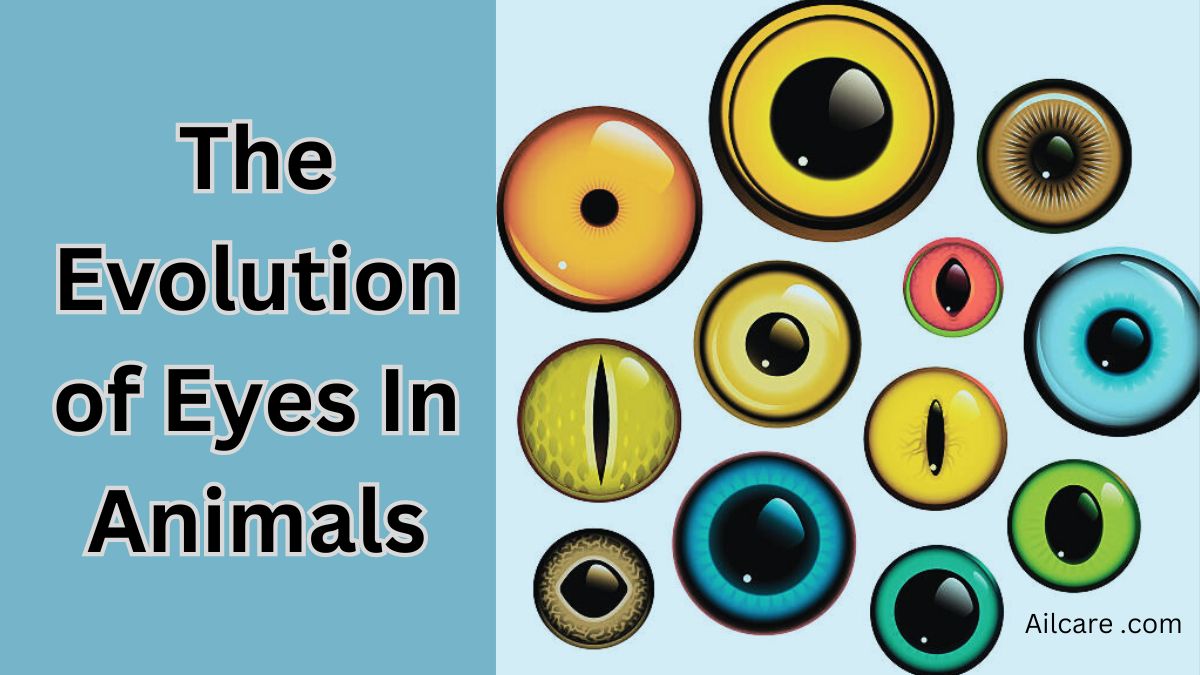
Among mammals a very great difference exists in the shape of the pupil when it is contracted. The domestic cat has a narrow Vertical pupil, which it needs for the purpose of hunting its prey up and down trees. (This is not true of all the càt family; lions and all the larger Felidae have round pupils.)
The horse has pupils which are wide horizontally in order that the animal, when grazing, can see sideways, both to right and to left, over a wide expanse of ground. A horse’s eyes are placed prominently up and out on the corners of its head so that it can aim a kick at a wolf—the horse’s natural enemy—without turning the head.
All eyes that shine in the dark do so by virtue of a concave reflector behind the retina. The purpose is to enable the animal to see better in the dark. The little light that is stirring in the outer world enters the pupil, passes through the transparent retina, which utilizes this light for vision, and on to the reflector, which sends it back to the same object from which it came. Here it is joined to the fresh, original light from the object, and the same process is repeated.
The Evolution of Eyes In Carnivora
Thus the Carnivora and some other animals, whose vision is very much poorer than ours by day, see much better at night. And that is why primitive man lived in great terror of the dark. He was eater by day, eaten at night.
All the primates have strong focusing muscles. In all the monkeys and apes the eyes, just as in man, can both be converged on the same point, and stereoscopic vision thus obtained—but not very long maintained. Only in man, of all the mammals, does there seem to be continuous binocular and stereoscopic vision. Even in the human child, however, the eyes do not as a rule move in perfect unison with each other till about three months after birth, because stereoscopic vision, in the history of life, is of extremely recent appearance. This is the reason for the ready LOSS-of-binocularity (cross-eyes) in many people as the result of eyestrain.
The Evolution of Eyes in Human
Whenever our eyes are in motion they are stone-blind, excepting only when they move without changing the point at which they look. Anyone can easily convince himself of the truth of this statement. Let him stand before a mirror and look at the image of one of his eyes. Let him look first at the right side of that eye, then at the left side of the same eye, and then back again. Never, so long as he lives, will he see his eye in motion. The reason is that, just as soon as an eye begins to move, it is blind.
We are never conscious of the blind interval, partly because the picture which is last seen before the eye begins moving persists in the sight canter of the brain and thus laps a little over the interval during which the retina is blind. But the chief fact is that the retina, by means of its motion blindness, gets minute intervals of rest with very great frequency all through our waking hours. In this way, the blurry and therefore useless pictures which we would receive if the eyes saw while in motion are avoided.
One peculiar thing about man’s eyes is not found in the eyes of animals. In all mammals the eyes are two little cameras, each producing a tiny picture, but in the brain of man only one composite or stereoscopic picture is seen.
The Evolution of Eyes The Evolution of Eyes The Evolution of Eyes The Evolution of Eyes The Evolution of Eyes The Evolution of Eyes The Evolution of Eyes The Evolution of Eyes
How Medicine Is the Mother Of Science